The Black Museum
1952
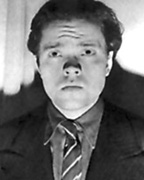
Orson Welles was the host to Scotland Yard's Museum of Murder, the so called Black Museum.
The Black Museum was a "Towers of London" production. It was broadcast over Radio Luxembourg in 1951 and was syndicated in America in 1952 (enteringthemindseye.com). Orson Welles added prestige to the role of tour guide. Listeners would hear his somber voice and slow footsteps echoing throughout the stone halls of the Black Museum as he pointed out various items that were used in actual murders. It could be something as serious as a razor, or something as seemingly innocent as an umbrella. Whatever it was, the audience knew it had successfully killed someone, and there hangs the tale! Welles would use the item to introduce a flashback sequence that would eventually tell the entire story. He would return afterwards to explain who was caught and how they were punished. This was back in the good old days before liberal Europe abolished capital punishment, so the items in the Black Museum usually caused the deaths of at least two people... the victim and whoever murdered that person. So we got an added bonus of two for the price of one!
The ambiance of this series was the most remarkable aspect of it. It was a brilliant setting and listeners couldn't help but visualize Orson Welles walking though a dark, dank museum after hours. It was like seeing a preview of Rod Serling touring The Night Gallery, only we saw it in our imagination instead of on TV. Welles would casually pick up or point out various murder weapons and examine them, all the while droning on about the related crime as if it were a medical procedure. He never got excited, but what he described in academic tones was usually sensational and often gruesome. To make sure the listener didn't miss the irony, a dramatic music cue would underscore such instances. This wasn't done in a subtle way either, but more like the musical equivalent of fireworks and pyrotechnics being detonated each time. One wonders if Welles cringed when he realized how often they were inserting these jarring musical stings in his otherwise sophisticated narrations. It's so overdone, it becomes humorous. But at this particular point in his life, Welles was in trouble personally, professionally, and with the IRS, so he wasn't in much of a position to throw his weight around. (That's why he was self-exiled overseas during the production of this series in the first place. (Digital Deli Too))
England has always been a great magnet for tourists. Exploiting famous evidence from Scotland Yard for commercial entertainment purposes seemed to be an obvious formula just waiting to be executed (no pun intended). Whitehall 1212 and Secrets of Scotland Yard had hit upon similar formats earlier, but it was the grim atmosphere of horror that Welles provided that made this series the best of the bunch. Welles was so effective at setting up each episode, that the actual stories sometimes seemed tame in comparison. The actors, music, and sound effects were good, but Welles was so much better that he often stole the show. Fortunately, he would return and conclude the story as well, filling us in on all the grizzly details. So it was like eating an average dinner with a spectacular appetizer and an incredible dessert! Although the show wasn't uniform from start to finish, it's difficult to resist listening to, if only for the thrill of hearing the creepy introductions and lurid endings.
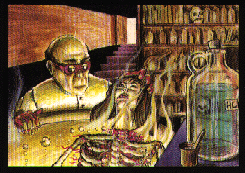
Artist depiction of "A Jar Of Acid" episode, courtesy Tune In For Terror © 1992
The Standard Intro:
Orson: "This is Orson Welles speaking to you from London...
(Big Ben chimes in the background.)
"From the Black Museum. The depository of death. Yes, here in a grim stone structure on the Thames which houses Scotland Yard, is a warehouse of Homicide. Here, everyday objects, a silk scarf, a length of twine, a child's toy, all our touched by murder."
(Music flairs)
An Opening Narration:
Orson: "Now this jar, probably one of those cheap glass containers, the type you would find in a laboratory, what's in it? A clear fluid. Water perhaps? A cleaning spirit? No...."
(Excerpt from story plays.)
"Today, that jar, containing the acid sample, can be seen in the Black Museum."
(Announcer): "From the annals of the Criminal Investigation Department of the London Police, we bring the dramatic stories of the crimes recorded by objects in Scotland Yard's Gallery of Death: the Black Museum."
(Reverberating foot steps. The host's voice echoes slightly, sounding as if in a large marble hall.)
Orson: "Well, here we are, in the Black Museum. Scotland Yard's Museum of Murder. Here lies Death. Unseen but ever present. Uncataloged, but orderly. Enveloping the shadows, papering the walls, carpeting the floor. Death. For display purposes, only. Here's a hypodermic syringe. It was once used to inject life preserving serums and later used to inject poison. And there... is an umbrella. An ordinary, everyday umbrella. Ordinary and everyday up to a point...
Sfx: (Loud click.)
"Look closer and you'll see just how sharp that point is. Just how lethal a sword stick can be as a weapon of murder.
"Ah, here we are, here's the acid jar. Sealed and somber looking on its place on the shelf. Once this jar rested on another shelf, a workshop shelf in Krawly. But lets not anticipate, let's begin our story at its beginning. Not on a shelf in a workshop in Krawly but in the dining room of a hotel in Kingsington. Dinner time. In one corner of the room at a table set for two, sits an attractive, fashionably dressed woman. She's joined by another who's equally attractive and equally fashionably dressed..."
An Ending Narration:
Orson: "James Gerald Hart made no attempt to deny the accusation of murder that was subsequently leveled at him. On the contrary, knowing that the game was up, he admitted his guilt freely. Stating he had first shot Mrs. Reagen, then deprived her of her clothing and her jewelry, then deposited her body in the drum of acid. A sample of which, today, occupies this position of honor in the Black Museum."
(Commercial.)
Orson: "The defense, brilliantly conceived, was of course, insanity. To strengthen his plea, Hart cheerfully claimed to have done away with no less than nine other victims in a similar fashion to that in which he had disposed of Mrs. Reagen. Whether or not this claim was justified will probably never be known. But it is an established fact that at the time of his trial, five of those he had named as his victims had been missing from their homes for months. They have not been found to this day. However, justified or not, his plea was rejected and he was found guilty of murder in the first degree. His subsequent execution relieved the world of a murderous student who set up and practiced before taking his diploma. For James Gerald Hart was by no means an accomplished killer. The trail he left behind him bares out that fact. Properly described as a dabbler in the art of dealing death who dabbled just once too often."
Sfx: (Footsteps.)
The Standard Closing:
Orson: "And now, until we meet next time in this same place, I'll tell you another story about the Black Museum. I remain as always, obediently yours..."
Sfx: (Door opens and shuts.)
Hear it now, FREE!
(courtesy OTR.Net)
Hear up to 19 different episodes of The Black Museum in Real Player!
(RealPlayer allows you to continue to browse other sites while you listen.)
"The Bed Sheet" (Courtesy of OTR.cat) - A luxury liner is the scene of a murder for profit, and the body is disposed of at sea.
"The Bath Tub" - A man with multiple wives in different towns decides to get rid of a few (and collect the insurance) by drowning them in their bathtubs.
"The Doctor's Prescription" - After a lady with long term health issues puts her nurse in her will, her health suddenly deteriorates.
"The Lady's Shoe" - A late marriage between a middle aged couple starts to go sour. When the wife announces her plans to divorce her husband, she disappears before she can hire a lawyer.
Hear 30 additional episodes courtesy of EnteringTheMindsEye.com
OTR Plot Summaries of The Black Museum episodes: http://webspace.webring.com/people/as/sittingduck_1313/blackmuseum.html
rev. 5.25.10**